
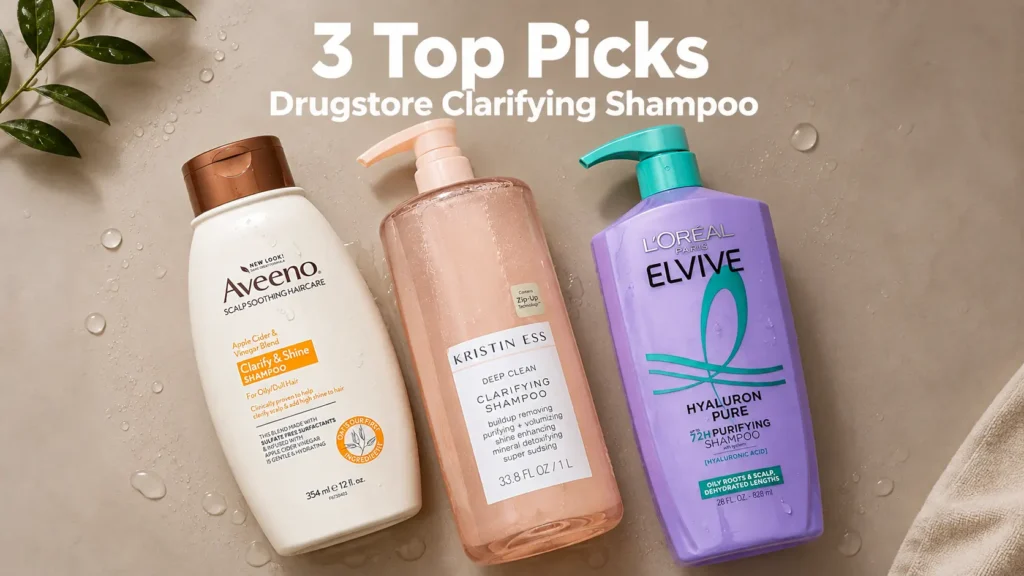
If your hair looks flat within a day of washing, feels coated no matter how much you shampoo, or just doesn’t respond to your usual products anymore, the best drugstore clarifying shampoo can often solve the problem for less than $20. Buildup from styling products, dry shampoo, hard-water minerals, and everyday oil accumulates on hair in a way that regular shampoo isn’t always strong enough to remove, which is where a dedicated clarifying formula comes in.
This guide compares three widely available drugstore clarifying shampoos
- Aveeno Apple Cider Vinegar Clarifying Shampoo
- Kristin Ess Clarifying Detox Shampoo
- L’Oréal Paris Elvive Hyaluron + Pure 72H Purifying Shampoo
Based on their ingredient lists, brand specifications, and patterns in publicly available customer feedback. None of these picks were personally tested; every recommendation below is built on manufacturer data, ingredient databases, and review trends from major retailers.
Picking the right one comes down to what’s actually causing the problem in your hair: everyday oil, heavy styling residue, hard-water minerals, or a sensitive scalp that can’t handle an aggressive formula. The breakdown below is organized so you can match your specific issue to the shampoo built to address it.
Quick Picks
- Best Overall : Kristin Ess Clarifying Detox Shampoo (~$19.00 / 33.8 fl oz): Formulated with disodium and tetra-sodium EDTA alongside sulfate cleansers, this is the pick built specifically for hard-water minerals, styling residue, and silicone buildup.
- Best for Sensitive or Color-Treated Hair : Aveeno Apple Cider Vinegar Clarifying Shampoo (~$8.57 / 12 fl oz): A sulfate-free formula built around colloidal oatmeal and apple cider vinegar, positioned by Aveeno as gentler than a traditional deep-clean shampoo.
- Best for Oily Roots + Dry Ends : L’Oréal Paris Elvive Hyaluron + Pure 72H Purifying Shampoo (~$9.47 / 28 fl oz): Pairs salicylic acid with sodium hyaluronate in a formula L’Oréal markets as purifying the scalp while hydrating the lengths.
How to Choose a Clarifying Shampoo: What Actually Matters
Not every “clarifying” label means the same thing, and picking the wrong one can leave hair either still dirty or unnecessarily stripped. A few factors are worth understanding before you buy.
Cleansing strength
Most clarifying shampoos rely on sulfate or sulfate-adjacent surfactants (like sodium laureth sulfate or sodium C14-16 olefin sulfonate) because they’re simply more effective at lifting oil and product residue than gentler cleansers. The tradeoff is that stronger surfactants can also strip the natural sebum that keeps hair soft, which is why dermatologists generally recommend using clarifying formulas periodically rather than as a daily shampoo. The Cleveland Clinic notes that over-washing removes the sebum hair needs for moisture and can lead to brittleness over time, which is the core reason clarifying shampoos are positioned as an occasional treatment rather than an everyday cleanser.
What kind of buildup you actually have
This is the most misunderstood part of the category. Traditional clarifying shampoos are built to dissolve oil, sweat, and product residue like silicones, gels, and dry shampoo but they aren’t necessarily formulated to remove dissolved minerals from hard water. Shampoos that specifically list EDTA-type ingredients (like disodium or tetrasodium EDTA) are chelating minerals rather than just cleansing, which is a meaningfully different mechanism worth checking the ingredient list for if hard water is your main issue.
Sulfate-free vs. sulfate-based
Sulfate-free formulas tend to feel gentler and are generally the safer starting point for color-treated, chemically processed, or sensitive-scalp hair, since they clean effectively without being as aggressive on the hair cuticle. Sulfate-based formulas clean more thoroughly in a single wash but carry a higher risk of dryness or faster color fade with frequent use.
Scalp vs. length application
The American Academy of Dermatology recommends washing hair based on how often the scalp actually gets oily rather than on a fixed schedule, and applying shampoo mainly where oil accumulates the scalp and roots rather than scrubbing the full length of the hair, which helps limit unnecessary dryness on the ends.
Comparison Table
| Best Drugstore Clarifying Shampoo | Aveeno Apple Cider Vinegar Clarifying Shampoo | Kristin Ess Clarifying Detox Shampoo | L’Oréal Elvive Hyaluron + Pure 72H Purifying Shampoo |
|---|---|---|---|
| Best for | Sensitive scalp, color-treated hair | Heavy buildup, hard water, oily hair | Oily roots with dry/dehydrated lengths |
| Size | 12 fl oz | 33.8 fl oz | 28 fl oz |
| Approx. price | $8.57 | $19.00 | $9.47 |
| Sulfate-free | Yes (uses olefin sulfonate instead) | No, contains sodium laureth and sodium lauryl sulfate | No, contains sodium laureth sulfate |
| Color-safe (per brand) | Yes | Yes | Yes |
| Key actives | Colloidal oatmeal, apple cider vinegar | Disodium/tetrasodium EDTA, botanical seaweed extracts | Salicylic acid, sodium hyaluronate |
| Standout trait | Gentlest cleansing system of the three | Only one of the three targeting hard-water minerals | Dual purify + hydrate formula |
| Main tradeoff | May not fully cut heavy hard-water buildup | Sulfate content may feel drying on fragile hair | Contains sulfates and fragrance |
Prices and formulas can change; always check the current listing and ingredient panel before purchasing.
1. Aveeno Apple Cider Vinegar Clarifying Shampoo

Size: 12 fl oz | Scent: Apple cider vinegar blend | Sulfate-Free: Yes | Color-Safe: Yes (per brand) | Approx. Price: $8.57
What We Like
- Uses sodium C14-16 olefin sulfonate rather than a traditional sulfate as the primary cleanser, a milder surfactant class according to ingredient breakdowns on INCIDecoder.
- Colloidal oatmeal extract is listed as the first active ingredient, which Aveeno’s own product page ties to its scalp-soothing positioning.
- Walmart’s product listing confirms the formula is marketed as sulfate-free and safe for color-treated hair.
- Contains PEG-7 amodimethicone, a lightweight conditioning silicone that can help offset the drying effect common to clarifying shampoos.
What to Consider
- The milder cleansing system that makes it gentle also makes it less likely to cut through heavy mineral or silicone buildup in a single wash.
- Contains added fragrance, which some sensitive-scalp users may want to patch-test for.
- “Apple cider vinegar” on the label refers to a formulated blend, not raw vinegar, so it shouldn’t be expected to behave like a DIY ACV rinse.
Full Analysis
Aveeno’s formula leans on colloidal oatmeal and a fragranced apple cider vinegar blend layered over a comparatively mild surfactant base. The full ingredient list shows sodium C14-16 olefin sulfonate and cocamidopropyl betaine doing the cleansing work, supported by conditioning polymers like polyquaternium-22 that help offset the stripping effect typical of clarifying formulas.
This combination is why the product reads as the gentlest of the three: it’s designed to lift oil and light residue while limiting the harshness that comes with heavier sulfate systems, which is consistent with its positioning as a shine-focused, sulfate-free option on both Aveeno’s own site and third-party retailers.
Who Should Buy It
- People with a sensitive or easily irritated scalp who still want a deeper clean than a daily shampoo provides.
- Color-treated hair, since the sulfate-free system is gentler on dye retention than the other two picks.
- Fine or oily hair that gets weighed down quickly and needs a light reset rather than an aggressive strip.
Who Should Avoid It
- Anyone dealing with confirmed hard-water mineral buildup, since the formula doesn’t list a dedicated chelating agent like EDTA.
- Fragrance-sensitive scalps, given the added fragrance in the ingredient list.
- People with heavy, multi-day dry shampoo or gel buildup who need a stronger single-wash reset.
Final Verdict: Aveeno is the safest starting point for anyone nervous about drying out their hair or fading color, and it’s the best drugstore clarifying shampoo pick if you’re not sure how aggressive a formula you actually need. Check the current listing.
2. Kristin Ess Clarifying Detox Shampoo
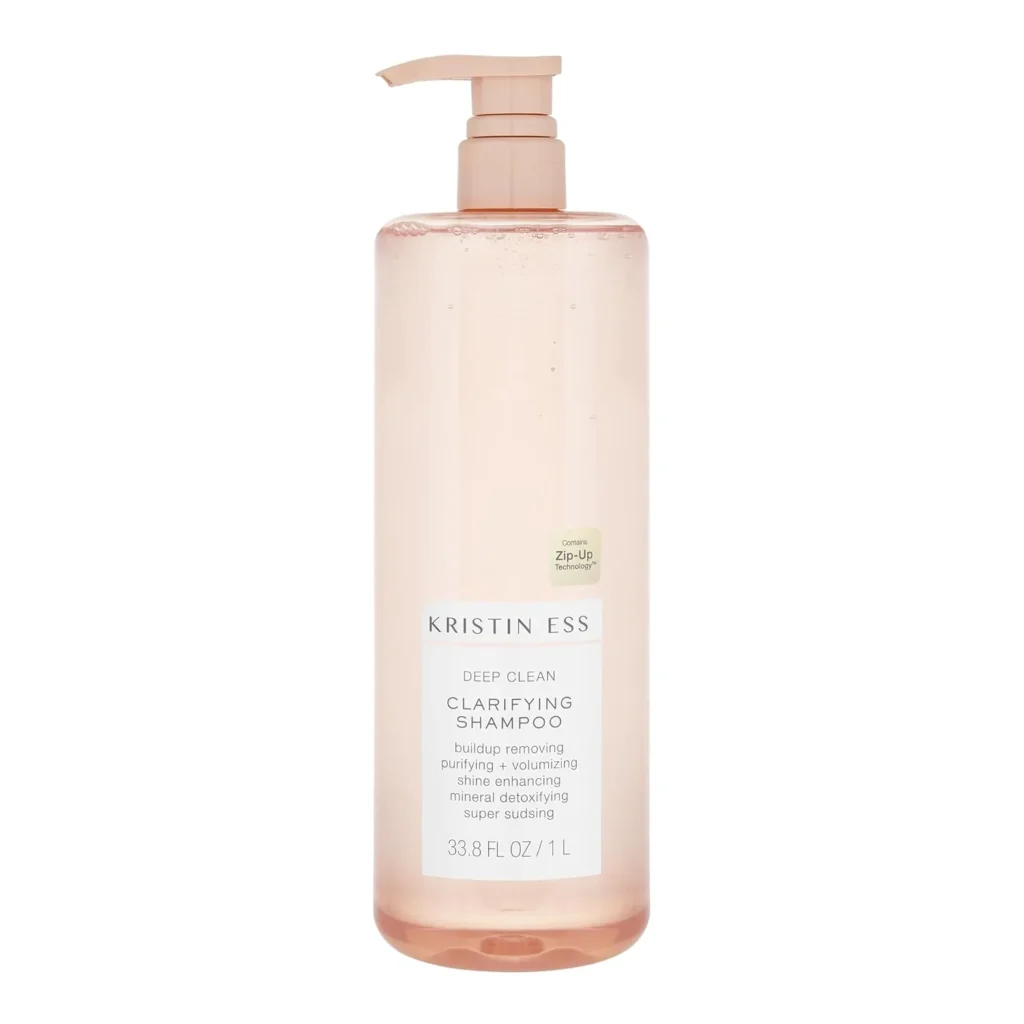
Size: 33.8 fl oz | Scent: Sandalwood | Sulfate-Free: No | Color-Safe: Yes (per brand) | Approx. Price: $19.00
What We Like
- Contains both disodium EDTA and tetrasodium EDTA, ingredients that bind mineral ions and are the reason this formula is marketed against hard-water buildup.
- CVS’s product listing confirms the formula targets mineral deposits, product buildup, excess oils, and silicones specifically.
- Ships in a large 33.8 fl oz pump bottle, which lowers the effective cost per wash compared to smaller clarifying shampoos.
- Positioned as vegan, cruelty-free, paraben-free, and phthalate-free.
What to Consider
- The listing on some retailers describes it as sulfate-free, but the full ingredient panel published by INCIDecoder shows sodium laureth sulfate and sodium lauryl sulfate near the top of the list always check your specific bottle’s ingredient panel rather than relying on marketing copy alone.
- The stronger cleansing system that makes it effective against hard water can also leave dry, curly, or chemically processed hair feeling rough without a follow-up conditioner.
- Contains added fragrance and a fragrance allergen (limonene), which may not suit sensitive scalps.
Full Analysis
What separates this formula from the other two is its EDTA content. Disodium and tetrasodium EDTA are chelating agents they bind to metal ions like calcium and magnesium so those minerals can rinse away instead of clinging to the hair shaft, which is the specific mechanism needed to address hard-water residue rather than just surface oil.
Layered on top of a sulfate-based cleansing system (sodium laureth sulfate and sodium lauryl sulfate, per the ingredient breakdown), this is a genuinely strong clarifying formula, and it’s the only one of the three built around a true mineral-binding ingredient rather than surfactant power alone. That strength is also its main tradeoff: the same sulfate system that removes mineral film and silicone buildup effectively can leave already-dry or porous hair feeling stripped.
Who Should Buy It
- Anyone in a hard-water area whose hair feels coated no matter how much they shampoo.
- Heavy users of dry shampoo, gel, mousse, or silicone-based styling products.
- Fine, flat hair that needs a genuine volume reset at the roots.
Who Should Avoid It
- Dry, curly, bleached, or chemically damaged hair that can’t tolerate a sulfate-based deep clean without follow-up conditioning.
- Anyone who saw “sulfate-free” on a listing and needs that specifically confirmed check the ingredient panel on your bottle first.
- People who only have mild, occasional product buildup and don’t need the strongest option in this comparison.
Final Verdict: Kristin Ess is the pick worth reaching for when regular clarifying shampoo isn’t cutting it and hard water or heavy buildup is the suspected cause just plan to follow it with a rich conditioner. Check the current listing.
3. L’Oréal Paris Elvive Hyaluron + Pure 72H Purifying Shampoo
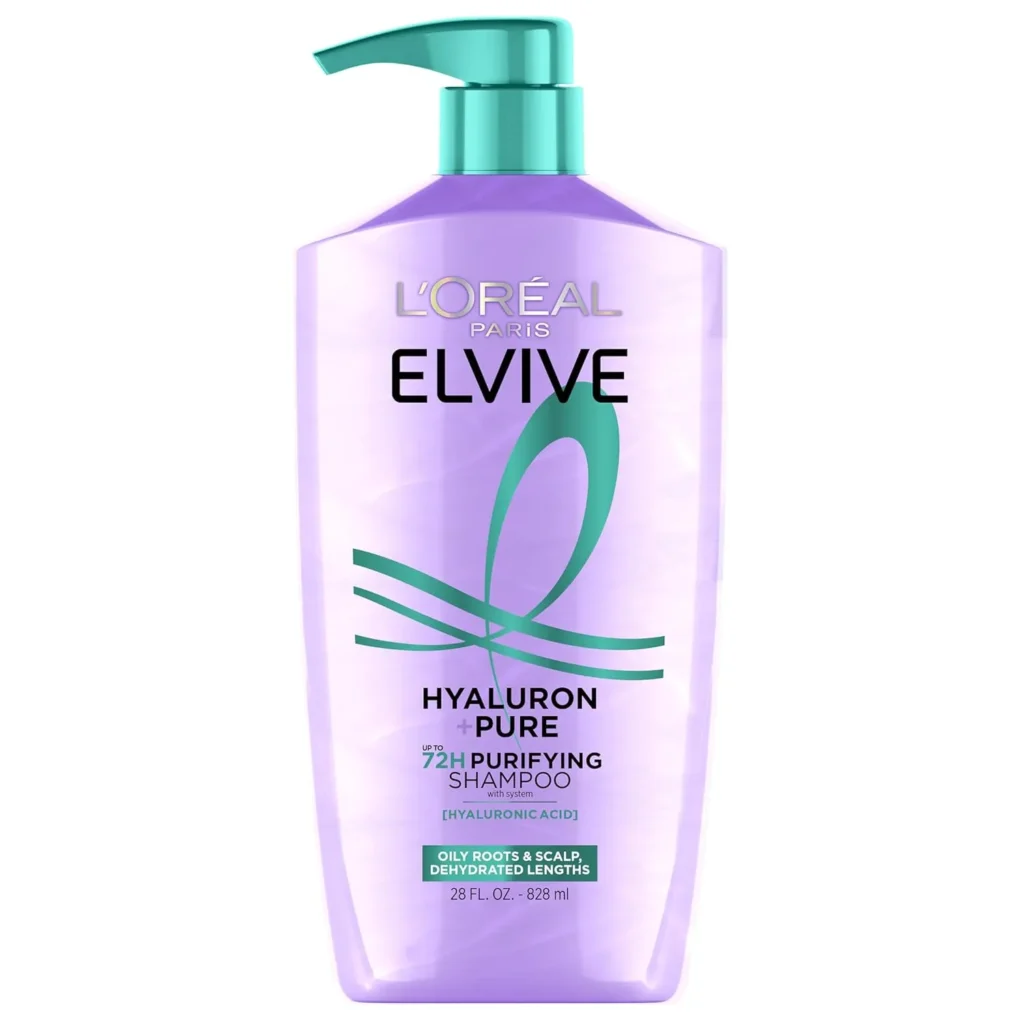
Size: 28 fl oz | Scent: Berries, cherry blossom, vanilla, sandalwood | Sulfate-Free: No | Color-Safe: Yes | Approx. Price: $9.47
What We Like
- Combines salicylic acid with sodium hyaluronate, a dual-action approach L’Oréal describes as purifying oily roots while hydrating the lengths.
- Large 28 fl oz bottle at one of the lowest per-ounce costs in the category.
- Target’s listing shows consistently positive review volume for the line.
- Salicylic acid is a well-established oil-dissolving, exfoliating ingredient in skincare, giving the “purifying” claim a legitimate mechanism rather than just marketing language.
What to Consider
- Uses sodium laureth sulfate as the primary cleanser, per the official ingredient list, so it isn’t a sulfate-free option despite the hydration claims.
- The hyaluronic acid is in a rinse-off shampoo, meaning any hydration benefit is inherently more limited than a leave-in product.
- The “72-hour freshness” claim is based on brand consumer testing and shouldn’t be read as a guarantee for every hair type or activity level.
Full Analysis
This formula borrows a skincare logic: salicylic acid to loosen oil and residue at the scalp, paired with sodium hyaluronate to soften the drying effect on the lengths. The ingredient list confirms sodium laureth sulfate as the main cleanser, working alongside cocamidopropyl betaine, with salicylic acid and sodium hyaluronate positioned as the differentiating actives.
That combination targets a specific, common complaint oily roots paired with drier ends better than a single, uniform clarifying formula would, since the salicylic acid concentrates its purifying effect at the scalp while the hyaluronate is intended to soften the cleansing impact along the length of the hair.
Who Should Buy It
- Oily-scalp, dry-ends hair, which is exactly the imbalance this dual-action formula is built to address.
- People who want a large, inexpensive bottle for regular (not just occasional) purifying washes.
- Normal to fine, straight hair, per the brand’s listed hair-type guidance.
Who Should Avoid It
- Curly or textured hair prone to frizz, since some users report the sulfate base contributing to frizz or dryness on the lengths.
- Fragrance-sensitive scalps the formula includes a multi-note fragrance and limonene.
- Anyone expecting hard-water mineral removal, since the formula’s actives (salicylic acid, hyaluronate) don’t include a chelating ingredient like EDTA.
Final Verdict: L’Oréal Elvive is the most balanced option for the specific oily-root, dry-end combination, as long as the 72-hour claim is treated as a brand test result rather than a promise. Check the current listing.
Clarifying vs. Chelating Shampoo: What’s the Difference?
These two terms get used interchangeably, but they describe different chemistry. Clarifying shampoos rely on stronger surfactants to dissolve and lift oil, sweat, and product residue like silicones and styling gels off the hair shaft. Chelating shampoos use specific binding agents most commonly EDTA that latch onto metal ions like calcium and magnesium and hold them in a soluble form so they rinse away, which is the mechanism actually needed to remove hard-water mineral deposits.
Industry sources on hair chemistry note that a clarifying shampoo without a listed chelating agent may improve the surface feel of hair without meaningfully reducing mineral buildup underneath it, which is why checking for EDTA (or a similar chelator) on the ingredient list matters if hard water is the specific problem you’re solving for. Of the three shampoos in this comparison, only Kristin Ess lists a true chelating ingredient.
How Often Should You Use Clarifying Shampoo?
Clarifying shampoo isn’t meant to replace your everyday shampoo. The American Academy of Dermatology frames wash frequency around how much oil an individual scalp produces rather than a fixed rule, and that same logic applies to clarifying frequency:
- Oily, straight hair: roughly once a week, or whenever buildup is noticeable.
- Normal hair: every two to four weeks.
- Dry, curly, or chemically treated hair: every three to six weeks, and only when needed.
- Color-treated hair: sparingly, and only with a formula explicitly marketed as color-safe.
- Heavy styling-product use: every one to two weeks may be appropriate.
A common mistake is using a clarifying shampoo daily or skipping conditioner afterward both of which increase the risk of dryness, especially with the sulfate-based formulas in this comparison. Applying shampoo mainly to the scalp rather than scrubbing the full length, then concentrating conditioner from mid-length to ends, helps limit unnecessary stripping on hair that’s already prone to dryness.
What Customers Are Saying
Across Amazon reviews for Aveeno’s clarifying shampoo, the product holds a 4.5-star average from more than 17,000 ratings, and it carries Amazon’s Choice status with strong recent purchase volume a pattern generally consistent with reliable, repeat-purchase satisfaction rather than a one-time promotional spike.
Across Amazon Kristin Ess’s 10 fl oz clarifying shampoo, the product holds a 4.52-star average from thousands of reviews, with buildup removal and hard-water performance frequently cited as strengths; some reviewers with dry or curly hair note the formula can feel stripping without a follow-up conditioner.
Across Amazon L’Oréal’s Elvive Hyaluron + Pure shampoo, the product is generally well-reviewed for its scent and oil-control performance on roots, with a smaller subset of reviewers noting the hydration claims feel more modest on the lengths than the marketing suggests.
Alternatives Worth Knowing About
- Neutrogena Anti-Residue Shampoo a long-running, minimal-ingredient clarifying formula built for weekly use. It’s worth noting the brand has listed the product as discontinued on its own site, so availability may depend on remaining retailer stock.
- Ouidad Water Works is a clarifying shampoo for curly hair designed to break down stubborn residue without pulling moisture out of your curls.
- Malibu C Un-Do-Goo is a clarifying shampoo for buildup formulated to remove styling product residue and resins while restoring shine, not stripping it away.
FAQ
Does clarifying shampoo remove hard-water buildup?
Not always. Standard clarifying shampoos are built to remove oil and styling residue, but mineral buildup from hard water specifically requires a chelating ingredient like EDTA. Of the three shampoos compared here, only Kristin Ess lists EDTA on its ingredient panel.
Is clarifying shampoo bad for color-treated hair?
It can accelerate fading if used too often, even with a “color-safe” label, since deeper cleansing naturally loosens some dye molecules along with buildup. Sulfate-free options like Aveeno’s are generally the more cautious choice for colored hair.
How often should I use a clarifying shampoo?
Most dermatology-based guidance points to roughly once every one to four weeks depending on hair type and oil production, per the American Academy of Dermatology, rather than as a daily replacement for your regular shampoo.
Can clarifying shampoo help with dandruff?
It can remove oil and flake residue, but it isn’t automatically an effective dandruff treatment on its own, since conditions like seborrheic dermatitis need targeted active ingredients (such as pyrithione zinc or ketoconazole) rather than just deeper cleansing.
Do I need to condition after using a clarifying shampoo?
Generally yes, especially with sulfate-based formulas like Kristin Ess or L’Oréal Elvive, since the stronger cleansing action that removes buildup can also leave hair temporarily drier than usual.
Public Source Reference
Dermatology-based guidance from the American Academy of Dermatology recommends basing wash frequency on how oily an individual’s scalp gets rather than following a universal schedule, and applying shampoo primarily to the scalp rather than the full hair length to limit unnecessary dryness guidance that applies directly to how and when a clarifying shampoo should be worked into a hair care routine.
Research Methodology
This article (Best Drugstore Clarifying Shampoo) was created after reviewing official product specifications, manufacturer information, independent ingredient-database resources, and publicly available customer reviews. We update our recommendations as products change.